Filters
Question type

Study Flashcards

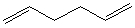
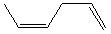
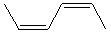
Which of the following dienes would you expect to be the most stable?


A) CH3CH2CH=CHCH2CH=CHCH3
B) CH3CH=CHCH=CHCH2CH3
C) CH2=CHCH2CH2CH2CH=CH2
D) CH2=CHCH=CHCH2CH2CH3
E) CH3CH2CH=C=CHCH2CH3

F) A) and B)
G) None of the above

Correct Answer

verifed

verified

Treatment of 4-methylcyclohexene with N-bromosuccinimide in CCl4 would yield mainly: Treatment of 4-methylcyclohexene with N-bromosuccinimide in CCl<sub>4</sub> would yield mainly:   A)  I B)  II C)  III D)  IV E)  All of the above


A) I
B) II
C) III
D) IV
E) All of the above

F) None of the above
G) B) and D)

Correct Answer

verifed

verified

The first step in the total synthesis of synthetic cholesterol involves production of the intermediate structure shown.Which combination of diene and dieneophile will result in its preparation? The first step in the total synthesis of synthetic cholesterol involves production of the intermediate structure shown.Which combination of diene and dieneophile will result in its preparation?

Correct Answer

verifed

verified

The LUMO of 1,3-pentadiene has how many electrons in its ground state?


A) 1
B) 2
C) 3
D) 4
E) 0

F) D) and E)
G) C) and D)

Correct Answer

verifed

verified

How could the following synthesis be carried out?  How could the following synthesis be carried out?   A)  (1) Br<sub>2</sub>/CCl<sub>4</sub>; (2) CH<sub>3</sub>CH<sub>2</sub>MgCl,ether; (3) CH<sub>3</sub>ONa/CH<sub>3</sub>OH B)  (1) HBr,80 \degree C; (2) (CH<sub>3</sub>CH<sub>2</sub>) <sub>2</sub>CuLi,ether C)  (1) HBr,80 \degree C; (2) Mg,ether; (3) CH<sub>3</sub>CH<sub>2</sub>OH,then H<sub>3</sub>O<sup>+</sup> D)  More than one of the above E)  All of the above


A) (1) Br2/CCl4; (2) CH3CH2MgCl,ether; (3) CH3ONa/CH3OH
B) (1) HBr,80 °\degree C; (2) (CH3CH2) 2CuLi,ether
C) (1) HBr,80 °\degree C; (2) Mg,ether; (3) CH3CH2OH,then H3O+
D) More than one of the above
E) All of the above

F) All of the above
G) B) and E)

Correct Answer

verifed

verified

Which of these dienes is the most reactive in the Diels-Alder reaction?


A) 1,3-Butadiene
B) 1,4-Pentadiene
C) 2,3,-Dimethyl-1,3-butadiene
D) 1,2-Butadiene
E) 1,4-Cyclohexadiene

F) B) and E)
G) A) and D)

Correct Answer

verifed

verified

Which diene and dienophile would you choose to synthesize the following compound? Which diene and dienophile would you choose to synthesize the following compound?   A)  I B)  II C)  III D)  IV E)  None of these


A) I
B) II
C) III
D) IV
E) None of these

F) A) and B)
G) A) and D)

Correct Answer

verifed

verified

Which is the major product of the following reaction? Which is the major product of the following reaction?     A)  I B)  II C)  III D)  IV E)  None of these Which is the major product of the following reaction?     A)  I B)  II C)  III D)  IV E)  None of these


A) I
B) II
C) III
D) IV
E) None of these

F) C) and D)
G) C) and E)

Correct Answer

verifed

verified

Treatment of 2-butene (cis or trans) with Cl2 at 400 °\degree C would yield mainly:


A) CH2ClCHClCH2CH3
B) CH3CHClCH2CH3
C) CH3CH=CClCH3
D) CH3CH=CHCH2Cl and CH3CHClCH=CH2
E) CH3CHClCHClCH3

F) A) and B)
G) A) and C)

Correct Answer

verifed

verified

Which pair does not represent a pair of resonance structures? Which pair does not represent a pair of resonance structures?   A)  I B)  II C)  III D)  IV E)  All of these represent pairs of resonance structures.


A) I
B) II
C) III
D) IV
E) All of these represent pairs of resonance structures.

F) A) and C)
G) A) and E)

Correct Answer

verifed

verified

Estimate the stabilization energy for 1,3-butadiene using the heats of hydrogenation in Table 1. Table 1. Heats of Hydrogenation for Selected Compounds Compound Moles H2 Δ\Delta H(kJ mol-1) 1-Butene 1 -127 1-Pentene 1 -126 1,3-Butadiene 2 -239 Trans-1,3-Pentadiene 2 -226


A) 13 kJ mol-1
B) 15 kJ mol-1
C) 28 kJ mol-1
D) 239 kJ mol-1
E) 112 kJ mol-1

F) A) and E)
G) None of the above

Correct Answer

verifed

verified

Ignoring stereochemistry,the 1:1 reaction of bromine with 1,3-cyclohexadiene at 25 °\degree C in the dark and in the absence of peroxide forms which of these?  Ignoring stereochemistry,the 1:1 reaction of bromine with 1,3-cyclohexadiene at 25 \degree C in the dark and in the absence of peroxide forms which of these?   A)  I B)  II C)  III D)  IV E)  Both I and II


A) I
B) II
C) III
D) IV
E) Both I and II

F) A) and B)
G) A) and C)

Correct Answer

verifed

verified

Which alkene would you expect to have the highest heat of hydrogenation?


A)
Which alkene would you expect to have the highest heat of hydrogenation? A)    B)    C)    D)    E)
B)
Which alkene would you expect to have the highest heat of hydrogenation? A)    B)    C)    D)    E)
C)
Which alkene would you expect to have the highest heat of hydrogenation? A)    B)    C)    D)    E)
D)
Which alkene would you expect to have the highest heat of hydrogenation? A)    B)    C)    D)    E)
E)
Which alkene would you expect to have the highest heat of hydrogenation? A)    B)    C)    D)    E)

F) A) and B)
G) A) and C)

Correct Answer

verifed

verified

Which set of conditions does not result in allylic halogenation of an alkene?


A) Cl2 at 400 °\degree C
B) Cl2 in CCl4 at 25 °\degree C
C) Cl2,ROOR,h ν\nu
D) Br2 at low concentration in CCl4
E) N-Bromosuccinimide in CCl4,ROOR

F) A) and E)
G) A) and D)

Correct Answer

verifed

verified

UV-vis spectroscopy can be used to indicate whether _________________ is present.

Correct Answer

verifed

verified

Which of the following dienes is a cumulated diene?


A) CH2=CHCH2CH2CH=CH2
B) CH2=CHCH=CHCH2CH3
C) CH3CH=C=CHCH2CH3
D) CH3CH=CHCH=CHCH3
E) CH3CH=CHCH2CH=CH2

F) B) and D)
G) C) and D)

Correct Answer

verifed

verified

A reaction under kinetic (or rate) control will yield predominantly:


A) the most stable product.
B) the product that can be formed in the fewest steps.
C) the product whose formation requires the smallest free energy of activation.
D) the product with the greatest potential energy.
E) the product with the least potential energy.

F) None of the above
G) A) and B)

Correct Answer

verifed

verified

An equilibrium-controlled reaction will yield predominantly:


A) the more/most stable product.
B) the product whose formation requires the smallest free energy of activation.
C) the product that can be formed in the fewest steps.
D) the product that is formed at the fastest rate.
E) the product which possesses the greatest potential energy.

F) D) and E)
G) B) and E)

Correct Answer

verifed

verified

Steroids are naturally occurring polycyclic compounds classified as lipids.The Diels- Alder reaction has been widely used in their preparation.Shown below is a precursor molecule used in a total steroid synthesis.What combination of diene and dieneophile can be used to prepare this compound through the use of a Diels-Alder cycloaddition reaction. Steroids are naturally occurring polycyclic compounds classified as lipids.The Diels- Alder reaction has been widely used in their preparation.Shown below is a precursor molecule used in a total steroid synthesis.What combination of diene and dieneophile can be used to prepare this compound through the use of a Diels-Alder cycloaddition reaction.

Correct Answer

verifed

verified

Which carbon-carbon bond in the following compound would you expect to be longest? Which carbon-carbon bond in the following compound would you expect to be longest?   A)  I B)  II C)  III D)  IV E)  V


A) I
B) II
C) III
D) IV
E) V

F) A) and D)
G) A) and C)

Correct Answer

verifed

verified

Showing 141 - 160 of 166

Related Exams

Show Answer