A) 5 and 6 billion.
B) 6 and 8 billion.
C) 10 and 15 billion.
D) 15 and 20 billion.
E) 20 and 25 billion.
G) B) and C)
Correct Answer

verified
Correct Answer
verified
A) density-dependent population regulation and intrinsic characteristics of population growth
B) exponential growth curves and unlimited environmental resources
C) density-independent population regulation and chance occurrence
D) pollution effects of a natural environment and learned shrimp behavior
E) a K-selected population switching to an r-selected population
G) A) and E)
Correct Answer
verified
Correct Answer
verified
A) the size of the area occupied by the population is increasing.
B) resources are distributed unevenly.
C) the members of the population are competing for access to a resource.
D) the members of the population are neither attracted to nor repelled by one another.
E) the density of the population is low.
G) None of the above
Correct Answer
verified
Correct Answer
verified
A) 3,800
B) 38,000
C) 380,000
D) 3,800,000
E) 38,000,000
G) A) and E)
Correct Answer
verified
Correct Answer
verified
A) 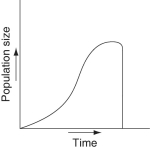
B) 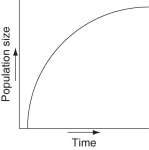
C) 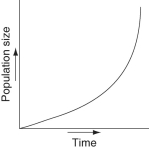
D) 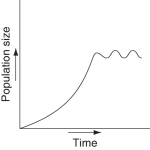
E) 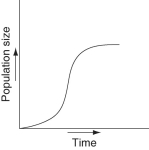
G) All of the above
Correct Answer
verified
Correct Answer
verified
A) carrying capacity
B) the fate of a cohort of newborn organisms throughout their lives
C) immigration and emigration rates
D) population dispersion patterns
E) reproductive rates
G) B) and E)
Correct Answer
verified
Correct Answer
verified
A) Owl populations frequent the area more often because of increased hunting success.
B) Females undergo hormonal changes that delay sexual maturation and many individuals suffer depressed immune systems and die due to the stress of overpopulation.
C) Clumped dispersion of the population leads to increased spread of disease and parasites resulting in a population crash.
D) All of the resources (food and shelter) are used up by overpopulation and much of the population dies of exposure and/or starvation.
E) Because the individuals are vulnerable they are more likely to die off if a drought or flood were to occur.
G) D) and E)
Correct Answer
verified
Correct Answer
verified
A) r
B) N
C) rN
D) K
E) dt
G) C) and E)
Correct Answer
verified
Correct Answer
verified
A) Pioneer species of plants produce many very small, highly airborne seeds, while large elephants that are very good parents produce many offspring.
B) Female rabbits that suffer high predation rates may produce several litters per breeding season, and coconuts produce few fruits, but most survive when they encounter proper growing conditions.
C) Species that have to broadcast to distant habitats tend to produce seeds with heavy protective seed coats, and animals that are caring parents produce fewer offspring with lower infant mortality.
D) Free-living insects lay thousands of eggs and provide no parental care, while flowers take good care of their seeds until they are ready to germinate.
E) Some mammals will not reproduce when environmental resources are low so they can survive until conditions get better, and plants that produce many small seeds are likely found in stable environments.
G) A) and C)
Correct Answer
verified
Correct Answer
verified
A) offspring with good chances of survival
B) many offspring per reproductive episode
C) small offspring
D) a high intrinsic rate of increase
E) early parental reproduction
G) A) and B)
Correct Answer
verified
Correct Answer
verified
A) a recently abandoned agricultural field in Ohio
B) the sand dune communities of south Lake Michigan
C) the flora and fauna of a coral reef in the Caribbean
D) South Florida after a hurricane
E) a newly emergent volcanic island
G) A) and C)
Correct Answer
verified
Correct Answer
verified
Correct Answer
verified
Correct Answer
verified
A) 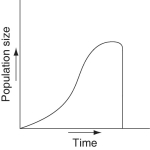
B) 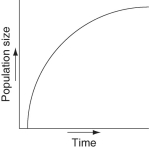
C) 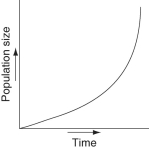
D) 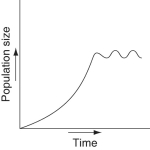
E) 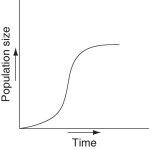
G) B) and D)
Correct Answer
verified
Correct Answer
verified
A) 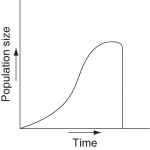
B) 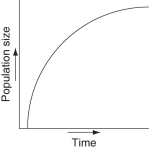
C) 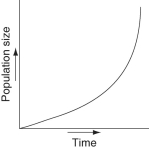
D) 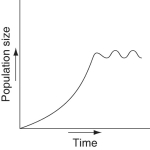
E) 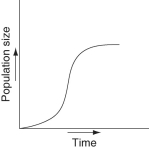
G) A) and C)
Correct Answer
verified
Correct Answer
verified
A) Earth's carrying capacity for humans is about 10 billion.
B) Earth's carrying capacity would increase if per capita meat consumption increased.
C) current demand by industrialized countries for resources is much smaller than the ecological footprint of those countries.
D) the ecological footprint of the United States is large because per capita resource use is high.
E) it is not possible for technological improvements to increase Earth's carrying capacity for humans.
G) All of the above
Correct Answer
verified
Correct Answer
verified
A) life expectancy, birth rate, and death rate.
B) number of reproductive females in the population, age structure of the population, and life expectancy.
C) age when reproduction begins, how often reproduction occurs, and how many offspring are produced per reproductive episode.
D) how often reproduction occurs, life expectancy of females in the population, and number of offspring per reproductive episode.
E) the number of reproductive females in the population, how often reproduction occurs, and death rate.
G) C) and D)
Correct Answer
verified
Correct Answer
verified
A) 50 to 60 years
B) 40 to 50 years
C) 30 to 40 years
D) 20 to 30 years
E) 10 to 20 years
G) A) and D)
Correct Answer
verified
Correct Answer
verified
A) counting the number of prairie dog burrows per hectare
B) counting the number of times a 1 kilometer transect is intersected by tracks of red squirrels after a snowfall
C) counting the number of coyote droppings per hectare
D) multiplying the number of moss plants counted in 10, 1m2 quadrats by 100 to determine the density per kilometer2.
E) counting the number of zebras from airplane census observations.
G) B) and D)
Correct Answer
verified
Correct Answer
verified
A) 120 individuals added
B) 40 individuals added
C) 20 individuals added
D) 400 individuals added
E) 20 individuals lost
G) A) and B)
Correct Answer
verified
Correct Answer
verified
A) I
B) II
C) III
D) I and II
E) II and III
G) A) and E)
Correct Answer
verified
Correct Answer
verified
Showing 61 - 80 of 80
Related Exams